Showing posts with label research. Show all posts

Thursday, September 21, 2006

Strategic Patenting Decisions and their Influence on Patent Value

As promised, here is part III –Which Patent Variables are indicators of Patent Value?


Again I ask, why is this important for the practicing attorney? As one who prosecutes patents and gives advice to clients on which applications to pursue and which to let abandon, this will give scientific weight to your advice.

In doing so I will answer the research question:
For firms what early strategic patenting decisions around the patent itself will impact the future value of the patent?


In my previous posts I looked at the 6 independent variables, all of them measured against the dependant variable of Forward Citations, which was used as a proxy for Patent Value.

The Statistical Analysis:
I performed a hierarchical regression analysis to test both the hypothesis with the enter method for the control variables and the stepwise method for the independent variables. The analysis was sorted across large and small firms to enable a comparison as well as to allow for detailed analysis of small firm patent characteristics. In controlling across Firm Experience and Industry, a hierarchical regression analysis was performed using predictors of Family Size, Breadth, Claim Count, Jurisdiction Count, Priority Basis and Provisional Basis.

The Results:
The results show support for the hypothesis for both small and large firms at the p < 0.05 level. For the small firm the model was significant at the p-value < 0.05 level for the independent variables of Industry Type, Priority Claim and Breadth of Patent whereas the Large firm had significance at the p-value < 0.05 level for the independent variables of Industry Type and Number of Claims. The R2 was 32% for the small entity, but only 9% for the large entity. This empirical result show support for the research question in that there are internal predictors that are associated with the value of the patent. However it should be noted that this implies that while predictors of significance were found for both small and large firms, it is more so the predictive results for small firms that should be contemplated for inclusion into business practices by industry.

Take Away Points:
How can I apply this to my firm? Small firms can benefit from this research by seeking to increase the value of their future patent portfolio by filing new patents that do not claim priority to other applications, yet cover a broad scope of technology.

How should I change my filing strategy? Dont' just churn them out. Simply having a patenting strategy that is focused on creating large patent portfolio counts, or having a standard procedure to patent all innovations across a pre-defined batch of jurisdictions will not necessarily lead to a portfolio with a high volume of valuable patents. They must consider each new innovation separately and make filing decisions accordingly and not based on pre-determined business decision procedures.

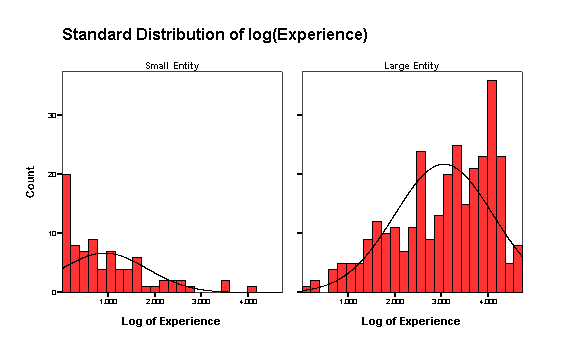
Can small firms really make a difference by patenting things? Does their lack of patenting experience matter? Although small firms have less patenting experience than large firms as seen by their experience distribution plots, surprisingly the firms patenting experience was not a significant predictor in the model. This suggests to industry that small firms with little or no patenting experience still have potential to create valuable patent portfolios from inception.

Saturday, July 29, 2006

Patent value & court decisions

A recent bump in traffic has come from someone posting about my citation/value research in Silicon Investor.

One reply to the thread said this : "interesting blog... It is, and goes back to the Glimstedt study of citations, but I'd be happier if he were listing court decisions based on the citation method of valuation."

Actually the citation method is tied to court decisions, it was just not the focus of this particular research paper. I am only posting a brief summary of the full paper here, hence you didn't see the link back to the references which ties litigated patents (which I will loosely interchange with court decisions here) and citations. For your reference here's the portion of my research that ties them together:

It has been suggested that given the high cost of litigation, patents which are litigated are also typically considered valuable patents. Research with litigated patents have been correlated to high patent citations (Lanjouw and Schankerman 1997; Allison, Lemley et al. 2004) with Allison arguing strongly for the bi-directional relationship between litigated patents and value. Their research argument is based on the premise of the high relative cost of litigation as compared to the cost of merely obtaining the patent with almost 75x the cost to enforce through litigation compared to filing.

An interesting step in the research would be to dive more deeply into the litigated patents and pull out the citation counts, ultimatly seeing if there is a model that can be developed for monetary settlements and citations.

References above:
Lanjouw, J. O. and M. Schankerman (1997). "Stylized facts of patent litigation: value, scope, ownership." NBER Working Paper (No. 6297).
Allison, J. R., M. A. Lemley, et al. (2004). "Valuable Patents." Georgetown Law Journal 92(3): 435.

Saturday, July 8, 2006

Patent data: foreshadowing of value to come

As promised, here is part II – Patent Variables to measure internal patent value.

Why is this important for the practicing attorney? As one who prosecutes patents and gives advice to clients on which applications to pursue and which to let abandon, this will give scientific weight to your advice.

First I will give a short background on how I “measured value” objectively for the patents in my data set.

Dependent Variable, or “measured value”: Forward Citation Counts

The dependent variable, forward citations, is measured by the number of citations the granted patent has from other patents. The variable was operationalized by counting the frequency of citations that the particular patent receives from subsequent patents as filed in the USPTO. I also controlled for self-citing.

Is this valid? I propose it is – Starting as early as 1990 forward citations have been validated by other research, showing that a general conceptual patent value or quality definition can be linked to the number of citations and external references it receives. The reasoning for the use of citations as a measure of value is the same for scientific literature: the economic importance of a work should be correlated with the frequency to which it is cited as a benchmark for further developments. It has been suggested that given the high cost of litigation, patents which are litigated are also typically considered valuable patents, and research with litigated patents have been correlated to high patent citations.

Independent Variables: Strategic Patenting Decisions
I am suggesting that each of these variables has an influence into the final value of a patent.

Family Size. Family size is all related applications (continuations, continuation-in-part and divisionals) filed worldwide.

Breadth. Patent breadth or scope is a measure of the technological influence or boundaries that the patent encompasses.

Claim Count. Claims define the legal boundaries of the patent rights, thus the firm typically has incentive to claim as much and as widely as possible while the examiner may narrow or reduce the claims to ensure validity before granting.

Jurisdiction. Jurisdiction size is computed as the number of separate country jurisdictions in which patent protection was sought for the same application.

Provisional Basis. Provisional applications allow an inventor to file information relating to their invention claim priority to that filing date up to 1 year from the original provisional filing date

Priority Claim. Priority claim is the basis of whether the patent application was based on a previous application, such as a continuation or divisional.

If you wish to see how I operationalized any of these variables let me know and I will post some additional details.

Next up: Part III – Results How did each of these independent variables fair when put to the statistical tests? And, more to the point, how can we apply this from a patent filing strategy perspective?

Thursday, April 27, 2006

New way to look at value of patents?

First off - let me apologize for the lengthy delays between postings. I was hoping for at least 2 a week when I started this site but other non-work obligations mean this site will fall to the bottom of my pile for at least another few months. I will keep you posted...

In the mean time, here is something to ponder:

Institute of Physics put out a news article on entitled "Google unearths physics gems". It outlines how the Google page rank algorithm is being used to find, and in some cases uncover, important scientific papers. On a personal note I used the google scholar extensively when doing research for my thesis last year and found it at least as valuable as, if not more, than some of the traditional searches such as ebscohost et al.

My question for the post is this: How can Google's page rank algorithm be used in patent searching and ranking, specifically to help do accurate prior art searches? How can it be used to help determine value of a filed or granted patent?

I think that is something worth postulating... Perhaps for my next thesis. Any thoughts or ideas would be interesting to hear...

Saturday, February 18, 2006

Patenting differences between large & small firms

Part I: Data Sources

My research interests lie in the patenting differences between large & small firms – and more importantly how can a small firm with relatively smaller resources get “more for their money” by having more valuable patents.
Those in the patent field realize that small firms have less experience than large firms, as measured by filed applications – but by enough to statistically compare the two groups? We must determine that before moving forward.

Data Source: The data collected was tested using patent data collected for US patents granting in January 1999[1] within the International (IPC) patent classes related to Electrical Devices (H01) and Mechanical Devices (F16). These particular classes were chosen as they were relatively opposite technically based categories allowing for a clear comparison across industries. A total of 847 samples drawn from the USPTO with both expired patents and those granted to non-US based firms removed from the sample. The remaining 386 samples were coded into Small and Large Entity status, as listed by each patent application record available from the USPTO.

Small and large firms patenting experience distribution, as measured by filed applications.


With negative skewness (-0.58) and kurtosis (-.457) for the large firms and positive skewness (1.25) and kurtosis (1.452) for the small firms, it can be seen that small firms have less experience than large firms, as measured by filed applications


(Sorry the background is black but SPSS was doing wierd output that I couldn't fix when importing into blogger - you need to click and open it to see the graph.)

So, with this difference in experience established in statistics we can move to comparing the two small & large firms patents.

Next: Part II – Patent Variables to measure internal patent value. I will be using claim count, patent breadth, patent jurisdiction size, number of claims, provisional basis and priority claims as my variables of value.


[1] A data-set from pre-November 29, 2000 was also consciously chosen as the law of the US now requires all US patent applications filed on or after this date to be published 18 months after the earliest filing date for which the benefit is being sought, unless the application will not be filed in a foreign country that provides for 18-month publications. Data collected after this date would cause issues as there would effectively be 2 data sets to consider: citations granted applications that had an earlier publication date and citations for granted applications that were not published.

Thursday, January 12, 2006

BasicIP's 6 Stages of Inventors

Today Rethink(ip) posted Bill Meade's part 1 of The 6 Life Stages of Inventors. As stated he does, on purpose, over simplify the article but as a result I think it causes a key point to be missed.

I think Bill definitely goes in the right direction with the start of his 6 stage. However, he seems to view one of the disruptive "off-ramps" from the bottom up where as I suggest a more prudent and long term view should be to address it from the top down in addition to Bill's bottom up approach.

This is where I thought he missed out on a key point: IP strategy needs to be supported from the top down and motivated from the bottom up. Simply motivating employees from the bottom up by giving them tools to overcome their anti-IP boss won't solve long term invention submission issues.
Contemplating short term fixes which include coaching the boss that people aren't "wasting time" by inventing doesn't seem to suggest that IP/Business training should be done at the manager and executive level. This should be done at, the very least, in parallel with employee training or incentive programs. Top level buy-in that IP is an asset to the company and should be taken seriously by everyone is a key success factor. I don't think merely stroking the non-supportive boss by making him a co-inventor makes long term sustainable advancements to the IP process. There needs to be an understanding that promoting and supporting IP furthers the business and long term value for the company. As well, just adding an inventor to make him happy may cause legal issues unless he really contributed to the invention.
War Story: Just by adding a boss to an invention caused huge litigation problems for a defendant in an IP lawsuit I was involved in. Simply "appeasing the boss" cost them an extra $10k or so in legal fees to sort it out a few years down the road once the other side found out about it.
I have found by spending time to really educate and promote the win-win benefits of IP to the management and executives, I have considerably more success in getting inventors to submit ideas and become involved in the patent processes. Why? Because the importance of IP and idea submission is preached to a wider audience (all staff) in several mediums (meetings, presentations, design reviews), all without a member of the IP Team there to remind them all.

On the inventor level while Incentive Programs motivate some, the enthusiasm fades quickly unless supported in parallel with fresh and innovative training programs. I have found success in doing both, but limited long-term success when I focus on just one.

BUT, all of the above is pointless unless quality ideas an innovations can be drawn from the inventors. Merely encouraging inventors to hit a quota of submissions does nothing for the value of the future patent portfolio. I am making an assumption by the title that Bill will address the quality of inventions in the "Calibration" stage.

I am looking forward to reading the rest of Bill's stages, and hope he addresses the quality/quantity issue.

And, for the record, I do like the cookie and T-shirt idea. I will try that one next time....

Saturday, January 7, 2006

Strategic Patenting Decisions and their Influence on Firm Patent Valuation

I finished my thesis in the area of patent strategy a few months ago and I will be posting revised and extended sections of it on this blog over the next month or so as I prepare it for publication. My research focused on the economic and business management side of IP, specifically related to small firms and their ability to positively influence their future patent portfolio value.

My interests were rooted in wanting to understand the business and economic drivers of IP in order to ensure more legal based successes in business practice.
Value can be measured in many different ways but I opted to use a relative "internal" value, using patent citation counts as the proxy for value. This is heavily used in research with academic IP focused Economic authors such as Manual Trajtenberg (Tel-Aviv University), Adam Jaffe (Brandeis University) and Bronwyn Hall (UC Berkeley).

Title: Strategic Patenting Decisions and their Influence on Firm Patent Valuation

ABSTRACT


The economic rents associated with patent portfolios are highly skewed with only a small portion having value. This leads researchers and industry to ask what early strategic patenting decisions around the patent itself will impact the future value of the patent, specifically within the context of small firms. To address this question the paper modeled these ex-ante strategic patenting decisions by using a common measurement of forward citations as a proxy for patent value. Six indicators were modeled with two of them, provisional basis and priority claim, not explicitly investigated in previous research.


A focus on the small firm as well as the two strategic patent decision indicators provisional basis and priority claim are areas that have not been explicitly investigated in previous research.

A stronger relationship was found for small firms with indicators of breadth and priority claims, as compared to a weaker relationship of only claim counts for large firms. Research also indicated that from a small firm management perspective the most potential valuable patent is one that covers a broad scope of technology is a new filing and does not claim priority to other applications.

I am working on a rewrite for publication , so any comments you have on the topic would be appreciated as they may influence my publication submission rewrite. In the mean time if you would like a copy for peer review, please let me know via email and I will send one your way.